

Have you ever wondered how product boxes get their unique shapes, perfect windows, or clean, foldable edges? That process is called die-cutting. It’s the key manufacturing step that turns flat sheets of material into three-dimensional packaging.
Understanding this process is essential for any brand, but it doesn’t have to be complicated or risky. The most important thing to know is that modern manufacturing has a safety net built in. You get to approve a perfect physical sample of your box long before any expensive tools are made.
Let’s explore how this process works and how it protects your investment while bringing your vision to life.
What is Die Cut?
Die-cutting is a manufacturing process that uses a specialized tool, called a die, to cut a specific shape out of a material like paper, cardboard, or plastic. Think of it like a cookie cutter, but for industrial purposes. It allows for thousands of identical shapes to be produced quickly and precisely.
However, before we even create that “cookie cutter,” we first make a prototype for you using a digital cutting plotter. This machine is like a highly precise robotic knife that follows a digital map. It creates a perfect, physical sample of your box that you can hold, test with your product, and approve.
Only after you are 100% satisfied with this sample do we create the metal die. This means the die is not a guess—it’s a tool built to perfectly replicate the sample you already love.
Key Elements of Packaging Die-Cutting
Die Types
The “die” is the heart of the process. The type of die used depends on the material’s thickness and the design’s complexity.
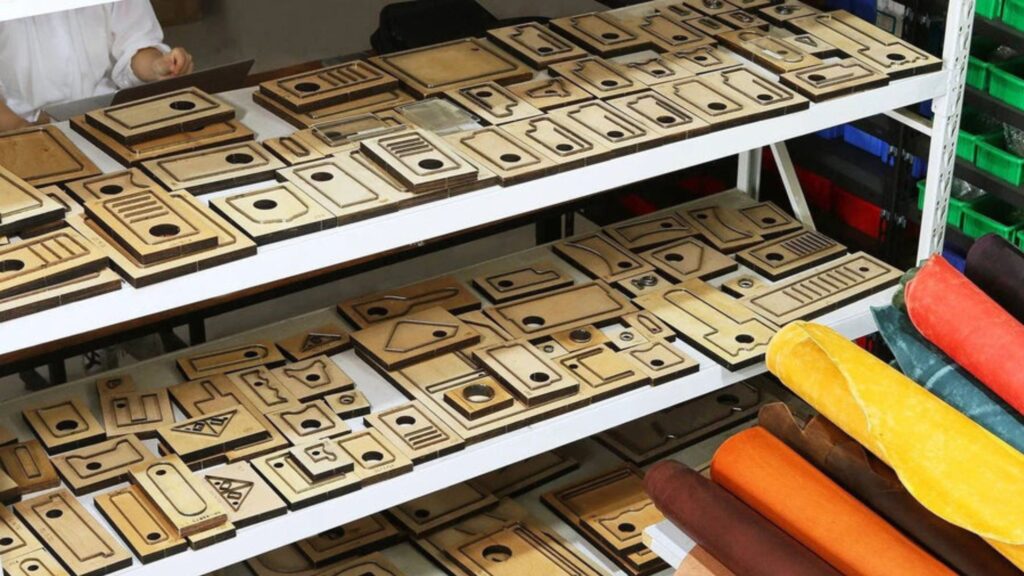
- Steel Rule Dies
Steel rule dies are made by bending sharp steel blades into the desired shape and embedding them into a wooden or plastic base. They are ideal for cutting thicker materials such as corrugated cardboard, paperboard, and foam.
- Strengths: Cost-effective for large production runs, versatile, and capable of handling thicker materials.
- Applications: Folding cartons, corrugated boxes, and custom inserts for packaging.
- Thin Dies
Thin dies (also called wafer-thin dies) are made from thin sheets of metal, typically used for precise and intricate cuts. They are best suited for thinner materials like paper and lightweight cardboard.
- Strengths: Excellent for detailed and decorative designs, suitable for small-scale or craft projects.
- Applications: Custom labels, decorative packaging elements, and detailed patterns in lightweight packaging.
A Deep Dive for Packaging Clients: The One-Time Tooling Fee
When we create custom packaging, the initial quote includes a fee for making the die. Here is the good news: this is a one-time investment. For all future re-orders of the same box, you will not pay this fee again. This significantly lowers the cost of your packaging over time, rewarding consistency in your branding.
Dieline/Dieboard Design for Die Cut
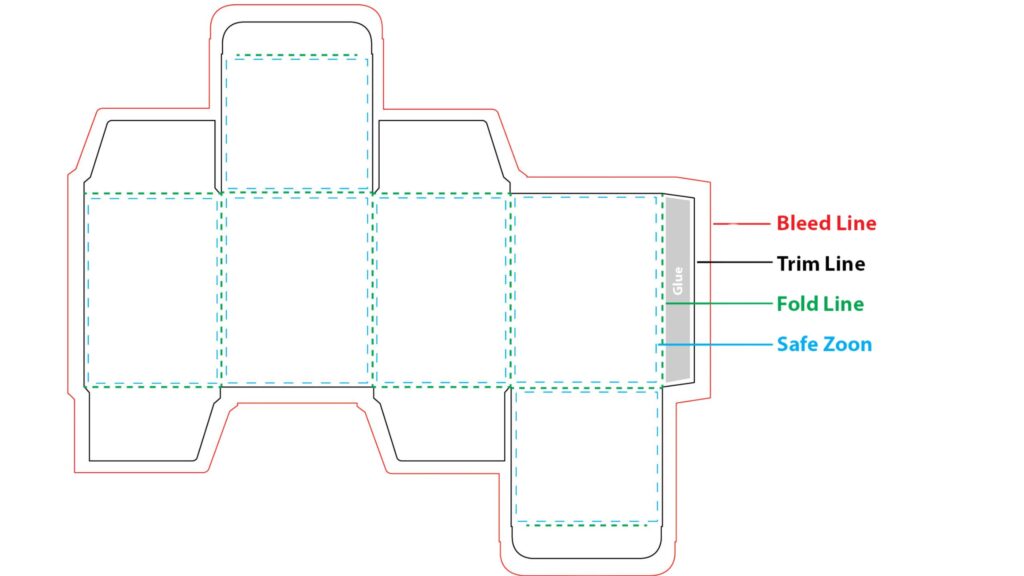
A dieline is the 2D blueprint or map for your packaging. It shows exactly where every cut, crease, and fold will be. This map is the critical link between your creative design and the final physical product.
- Bridging Design and Reality
A well-made dieline ensures that an innovative design (like a unique shape or window) is practical to produce. It balances creative vision with the physical limits of the material and machinery. - The Link to Printing and Finishing
The dieline tells the printing press exactly where graphics need to go so they don’t get folded in half or cut off. It ensures your branding looks perfect on the finished box. It also guides the machinery for precise folding and gluing, reducing waste and speeding up production.
A Deep Dive for Packaging Clients: Cost vs. Complexity
This is where a good manufacturing partner becomes a true consultant. A complex curve or an unusual angle on your dieline can sometimes increase the cost of the die.
Our experts can review your design and suggest minor modifications that might save you significant money without changing the look and feel of your package. This collaborative approach between designer and manufacturer is key to optimizing your budget.
Creasing and Cutting Mats
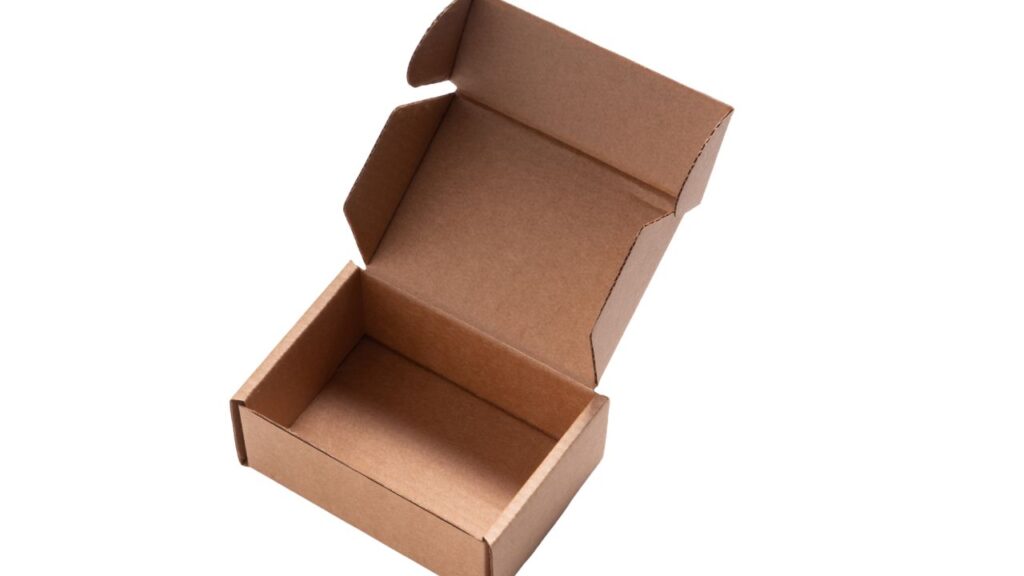
Cutting is only half the job. For a box to work, it needs to fold perfectly. That’s where creasing comes in.
- The Importance of Creasing
Creasing is the process of making an indentation in the material to create a perfect fold line. Without a proper crease, folding cardboard can cause it to crack or tear, ruining the box’s appearance and structural integrity. A good crease ensures every box folds cleanly and consistently. - The Role of Cutting Mats
Cutting mats are the surfaces that the material rests on during the die-cutting process. They provide a stable base that allows the die to make a clean, sharp cut every time. Using high-quality mats ensures every single box is cut with the same precision from the first to the ten-thousandth.
A Deep Dive for Packaging Clients: Shared Goals and Quality Control
As your manufacturer, we have a financial interest in making sure the die and the entire process are flawless. A poorly made die would waste our materials, our machine time, and our labor.
Our internal quality control is your guarantee. We absorb the technical risk because our success is directly tied to producing your packaging perfectly and efficiently.
Main Die Cut Process Types and Their Applications in Packaging

Main Die Cut Process Types and Their Applications
There are three main ways to perform die-cutting, each suited for different needs.
- Flatbed Die-Cutting
This process uses a flat die that presses down onto the material, much like a stamp. Flatbed die-cutting is extremely precise and is perfect for detailed designs and thicker materials.- Best for: Small to medium production runs, luxury packaging, and boxes with complex shapes or cutouts.
- Rotary Die-Cutting
This method uses a cylindrical die that rolls over the material. Rotary die-cutting is incredibly fast and efficient.- Best for: Very large production runs of simpler designs, like standard shipping boxes, where speed is the top priority.
- Digital Die-Cutting
This modern method uses lasers or CNC robotic knives to cut the material based on a digital file. Digital die-cutting requires no physical die at all.- Best for: Creating initial prototypes, very small production runs, or highly personalized packaging where every piece is different.
Applications for Flatbed Die-Cutting
Flatbed die-cutting is commonly used for:
- Folding Cartons: Pharmaceutical, cosmetic, and food packaging.
- Premium Boxes: Luxury packaging for jewelry, electronics, and high-end products.
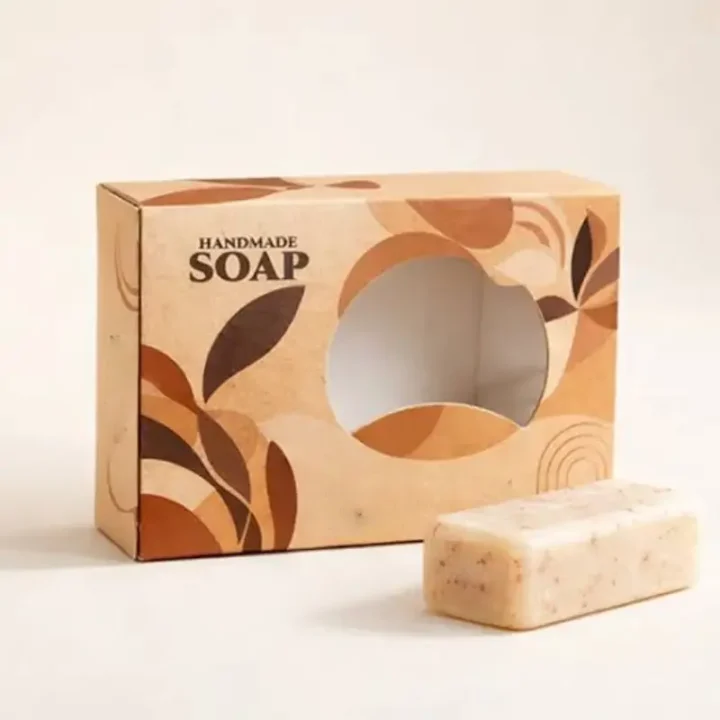
- Custom Packaging: Projects requiring unique shapes, detailed patterns, or premium finishes.
2.Rotary Die-Cutting
It uses cylindrical dies mounted on a rotary press to cut and crease materials as they move continuously through the machine.
Key Features:
- High efficiency and speed, making it ideal for mass production.
- Best suited for simple packaging designs with fewer intricate details.
- Handles materials like corrugated cardboard and kraft paper effectively.
Applications:
Primarily used for producing corrugated boxes, shipping cartons, and other straightforward packaging solutions where durability and volume are critical.
3.Digital Die-Cutting (Laser/CNC)

Digital die-cutting uses advanced technologies like laser cutters or CNC machines to cut and shape materials without the need for physical dies.
Key Features:
Highly flexible, allowing for quick design changes and fast turnaround times.
Ideal for intricate designs, fine details, and personalized packaging.
Eliminates the cost of creating traditional dies, making it suitable for low-volume production.
Applications:
Perfect for prototyping, sampling, small production runs, and custom or personalized packaging where precision and adaptability are essential.
4. Applications in Other Industries
Die-cutting is widely used in paper-product processing, textiles, and foam manufacturing. It offers precision and efficiency. Below are specific examples of applications in these industries and how it positively impacts production and product quality.
- Greeting Cards:
Die-cutting is used to produce uniquely shaped greeting cards with intricate patterns, pop-up designs, or cutouts, adding a personal and premium touch. - Photo Albums:
Precision die-cutting creates window cutouts, frames, and decorative layers for photo albums, enhancing their aesthetic and sentimental value. - Notebooks:
Custom die-cutting is used to design covers, dividers, or tabs in notebooks, making them more practical and visually appealing.
Conclusion
Die-cutting is a versatile and essential process that enhances product quality, boosts production efficiency, and reduces costs across various industries, from packaging to textiles and foam. Its ability to create precise, innovative designs makes it a cornerstone of modern manufacturing.
You don’t need to fear the cost of a bad die. With our process, by the time you invest in a die, it’s no longer a risk. It’s simply the key to scaling up a design you have physically held and already love.
Ready to explore how die-cutting can transform your products? Contact us today to discover tailored solutions for your industry!
 English
  العربية
  Deutsch (Sie)
  Español
  Français
  日本語
日本語  한국어
한국어  Italiano