

Are you a business owner selling products to customers? And thinking of using Corrugated Flutes for packaging your items?
Before you make any decision, it’s important to know types of flutes in corrugated box, how to properly use them, and which kind of flutes you should go for packing your items. Because these flutes determine crush resistance, shock absorption, printing surface quality, overall package weight, and more.
What do Corrugated Flutes Mean?
Instead of flat liner structure, in Corrugated boxes there’s a wavy, folded layer that is placed between two sheets of cardboard just like a sandwich.
These flutes play a big role in determining how strong a cardboard box can be. Corrugated flute cardboard boxes protect the inside content, especially during shipping, shifting, storing, and stacking.
Flutes come in different heights, sizes, and frequencies (no. of flutes per linear foot). Each type of flute is used for a different purpose to achieve strategic packaging. Let’s see different types and sizes of corrugated flutes along with their uses.
Different Types of Flutes in Corrugated Box
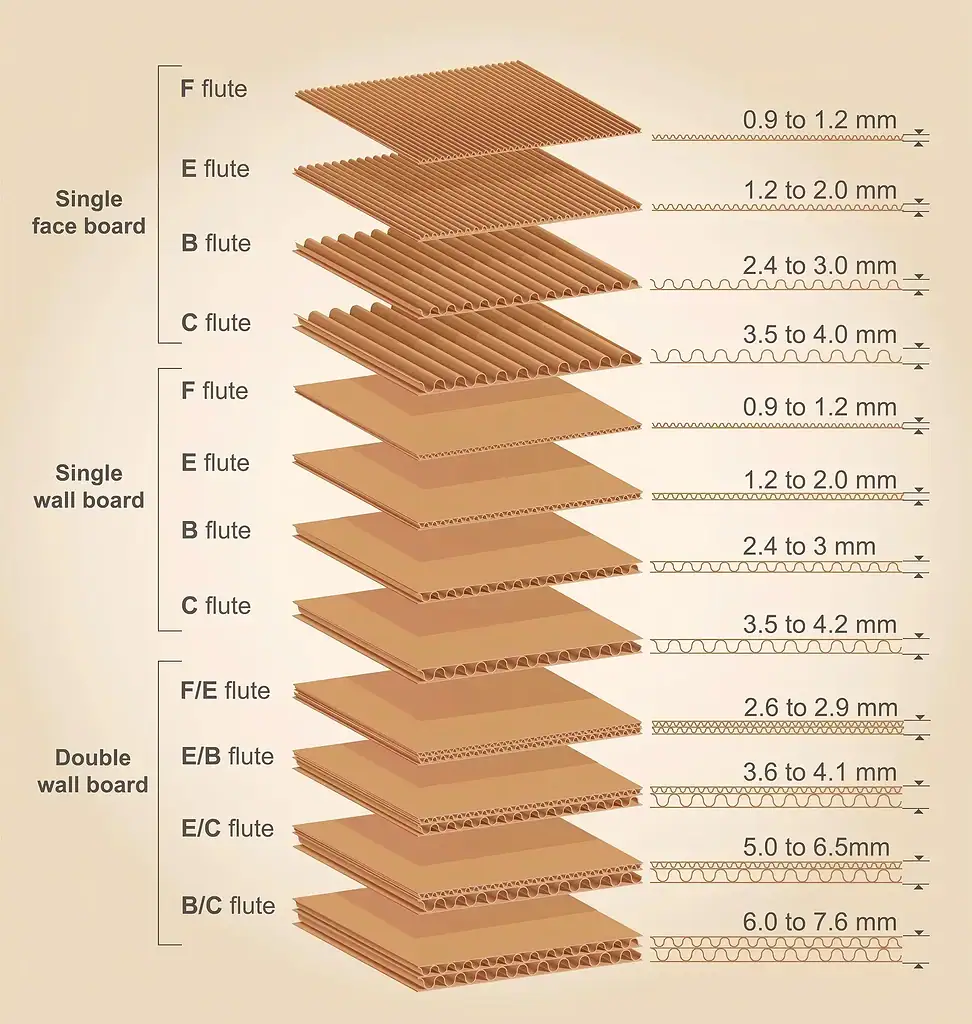
Corrugated flutes come in different ranges of sizes. They can be up to 5mm thick and 0.8mm thin. An interesting thing to know is that the names of the flutes move in alphabetical series, but it does not mean they are named according to their size.
Their name follows the pattern of when they were invented. The first one is given the name of the first alphabet letter A, the second one B, and so on.
- A-Flute
A-Flute has a thickness range of 4.00mm – 4.9mm, has a wavy structure, and is the basic type of corrugated flute that is thickest among its type.
This type of flute is perfect if better cushioning, insulation and compression strength are your targets. If your packaging has fragile content like glassware, heavy items like electronics, or ceramics, then choose A-Flute.
- 36 flutes per linear foot.
- High vertical compression strength.
- Superior shock absorption.
- 1/4 inch (5mm) thick.
Uses: For furniture, appliances, and glass products.
- B-Flute
B-Flute is thinner than both A-Flute and C-Flute. It has a smaller height, but there are more flutes per linear foot in B-Flute. They are mostly used in display packaging and shipping smaller items that don’t require heavy or excessive cushioning.
- Better crush resistance.
- Ideal for high-quality printing.
- 45-52 flutes per linear foot.
- Good printing surface.
- 1/8 inch (3.2 mm) thick.
Uses: Die-cut boxes, beverage carriers, POP displays, canned goods and retail packaging.
- C-Flute
C-Flute is thinner than A and thicker than B-Flute. It’s great when you need better cushioning while shipping heavy duty items making it the most common flute size.
- 39-41 flutes per linear foot.
- Good printability of graphics and labels for point-of-sale displays.
- Excellent balancing strength and can support the weight of multiple boxes stacked on top of each other.
- 3.5mm to 4mm
Uses: Shipping cartons, standard packaging, food items, beverages, and heavy appliances.
- E-Flute
The E-Flute comes in second place among its styles when it comes to thinnes. It’s thinner than a B-Flute. If you want a smooth surface for printing along with good crush resistance then go for E-Flute.
It’s ideal when you want to reduce storage space and costs.
- Ideal for brand packaging as it displays high-resolution printing.
- Eco-friendlier.
- 1.6 mm thickness.
- Reduce overall box weight and lower shipping costs.
- Minimal cushioning capability.
Uses: Cosmetics boxes, cereal cartons, small consumer goods, retail-ready packaging, tech packaging.
- F-Flute
F-Flute is the thinnest corrugated cardboard structure that has a very high flute density, higher than other flutes. It is thinner than E-Flute.
Still, you will find its structure rigid and strong. They offer an aesthetic kind of packaging vibe through small, elegant boxes.
It has a smooth surface that’s great for high-end printing and branding. It is not a perfect type for packing fragile or heavy items.
- 128 flutes per linear foot.
- Limited structural protection.
- Gives a premium appearance.
- Perfect for printing.
- 0.8 millimeters (1/32 inch).
Uses: Luxury packaging, retail packaging (like cosmetics, jewelry, shoe boxes), micro-packaging. Perfume boxes, high-end electronics.
- G-Flute
If compared with F-Flute, G-Flute is thinner and has high density, and it is not a very common type of corrugated flute cardboard. However, if you want it for displaying sharp graphics, then it’s one of the best choices after F-Flute.
- 140+ flutes per linear foot
- Low cushioning
- High surface smoothness
- Very lightweight
- Not very rigid
- 0.5mm thick

Uses: Packaging high-end electronics like smartphones, smartwatches, etc., or designer packaging, cosmetic boxes, and POP displays.
| Flute Type | Thickness | Flutes per Foot | Main Advantages | Typical Uses |
|---|---|---|---|---|
| A Flute | 4.0–4.9 mm | 36 | Excellent cushioning, high compression strength | Furniture, glassware, appliances |
| B Flute | 3.2 mm | 45–52 | Good printability, strong crush resistance | Retail packaging, beverage trays |
| C Flute | 3.5–4.0 mm | 39–41 | Balanced strength and cushioning | Standard shipping cartons, food packaging |
| E Flute | 1.6 mm | 90 | High-quality printing, space-saving | Cosmetic boxes, retail packaging |
| F Flute | 0.8 mm | 128 | Premium printability, elegant appearance | Luxury packaging, jewelry boxes |
Combination Types of Fluting in Corrugated Box
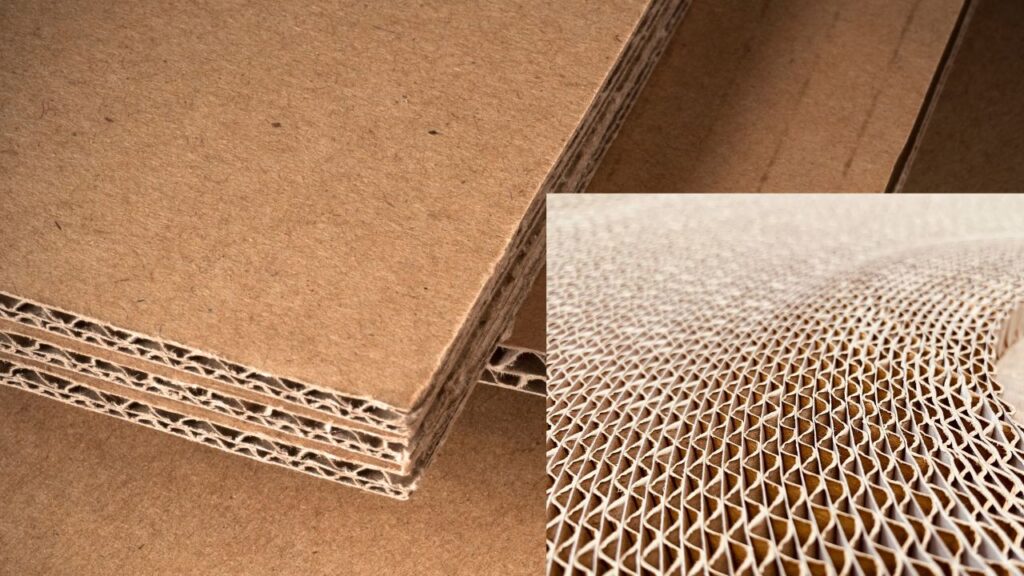
You know, you can also find combination flutes, aka double-wall or triple-wall corrugated boards, where two or more different flute types are joined together to create a hybrid structure. Combination flutes enhance;
- Strength
- Cushioning
- Rigidity
- Customizability
How are Combination Flutes Made?
Combination flutes mainly have this structure;
- Double-Wall Corrugated
It has two fluted middles and three linerboards
1st Linerboard + 1st Fluted Mid + 2nd Linerboard + 2nd Fluted Mid + 3rd Linerboard
For example, if A-Flute and B-Flute are combined, it will look like this;
AB-Flute → 1st Linerboard + A-Flute + 2nd Linerboard + B-Flute + 3rd Linerboard
- Third-Wall Corrugated
It has three fluted middles and four linerboards.
1st Linerboard + 1st Fluted Mid + 2nd Linerboard + 2nd Fluted Mid + 3rd Linerboard + 3rd Fluted Mid + 4rth Linerboard
For Example, if A-Flute, B-Flute, and A-Flute are combined, it will look like this;
ABA-Flute → 1st Linerboard + A-Flute + 2nd Linerboard + B-Flute + 3rd Linerboard + A-Flute + 4rth Lineboard
Common Combination Flutes and Their Uses
| Combinations | Uses |
| BC-Flute | Long-distance shipping boxes, industrial applications, and heavy products. |
| EB-Flute | Shipping heavy goods, moving boxes (like during shifting), retail packaging, e-commerce printed boxes. |
| AC-Flute | Heavy-duty appliances, fragile items. |
| AA-Flute | Enhances cushioning for extremely fragile or bulky items. |
| AB-Flute | Packing heavy equipment. |
Advantages of Corrugated Flutes
Here are the key advantages you can have from corrugated flutes;
- Strength and Protection
Cardboard boxes made of different types of Corrugated flutes not only keep the boxes strong and durable but also keep the items good and safe from any damage.
- Lightweight Structure and Storage Efficiency
These boxes are not heavy, so carrying or transporting them is easy. They also don’t take much space, as you can stack these boxes.
- Versatility
With different corrugated flute types, this cardboard can be used for different purposes, from carrying fragile items to designer packaging or POP display. Flute types like E-Flute or F-Flute also give a smooth surface for printing logos and designs.
what need to consider when choose different Types of Fluting in Corrugated Box
1. Selection Stage: Matching Corrugated Type to Product
If your product weighs ≤5kg and requires long-distance shipping
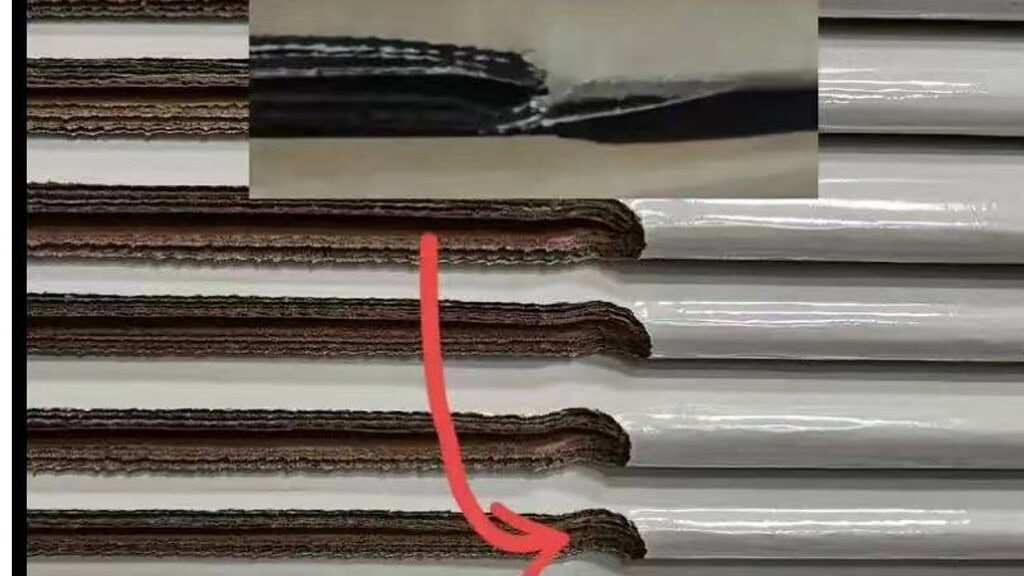
Risk: Choosing overly thick corrugated board (such as C-flute or BC double-wall, thickness >5mm) can lead to linerboard cracking under stacking pressure during transportation.
Recommendation: Switch to B-flute single-wall (thickness 3.5–4mm), which offers a compressive strength of 4200N/m² and reduces costs by 15%.
If your product is made of glass or is a precision instrument
Risk: Opting for low-cost E-flute (thickness 0.8mm) or F-flute (0.5mm) can result in inadequate cushioning, leading to product damage.
Solution: Use a 2mm thick EPE foam liner and an outer carton with A-flute or AB double-wall combination. This increases impact resistance by 60%.
2. Structural Design: Balancing Size and Load-Bearing
If the box height >80cm and needs to be stacked 5 layers high
Risk: Without reinforcement ribs or when using single-wall board, the bottom boxes may collapse, increasing the rate of structural failure by 40%.
Optimization: Add L-shaped reinforcement to the box corners (increase board thickness to 5mm) and limit stacking to a maximum of 3 layers.
If internal items have sharp edges (e.g., tools, metal parts)
Risk: Direct contact with the linerboard can cause scoring and cracking at creased areas.
Remedy: Add a 1mm thick EVA foam liner to distribute pressure onto the corrugated core.
3. Environmental Control: Adapting to Humidity and Season
If shipping in autumn or winter and transit time exceeds 7 days
Risk: If the board moisture content is too low (<6%), sudden drops in humidity during transit can cause the linerboard to crack.
Operational Guideline: Require suppliers to pre-condition the board with spray humidification (8–12% moisture) 24 hours in advance, and wrap the outer carton with PE film.
Key Takeaway
Now you have the key to making smarter packaging decisions with Corrugated flutes.
The right choice will not only protect your content but also provide other advantages like cost efficiency, sustainability, etc. So, do not let your packaging choice be an afterthought; choose wisely beforehand using this guide.Contact us to get your perfect packaging.



 English
  العربية
  Deutsch (Sie)
  Español
  Français
  日本語
日本語  한국어
한국어  Italiano