
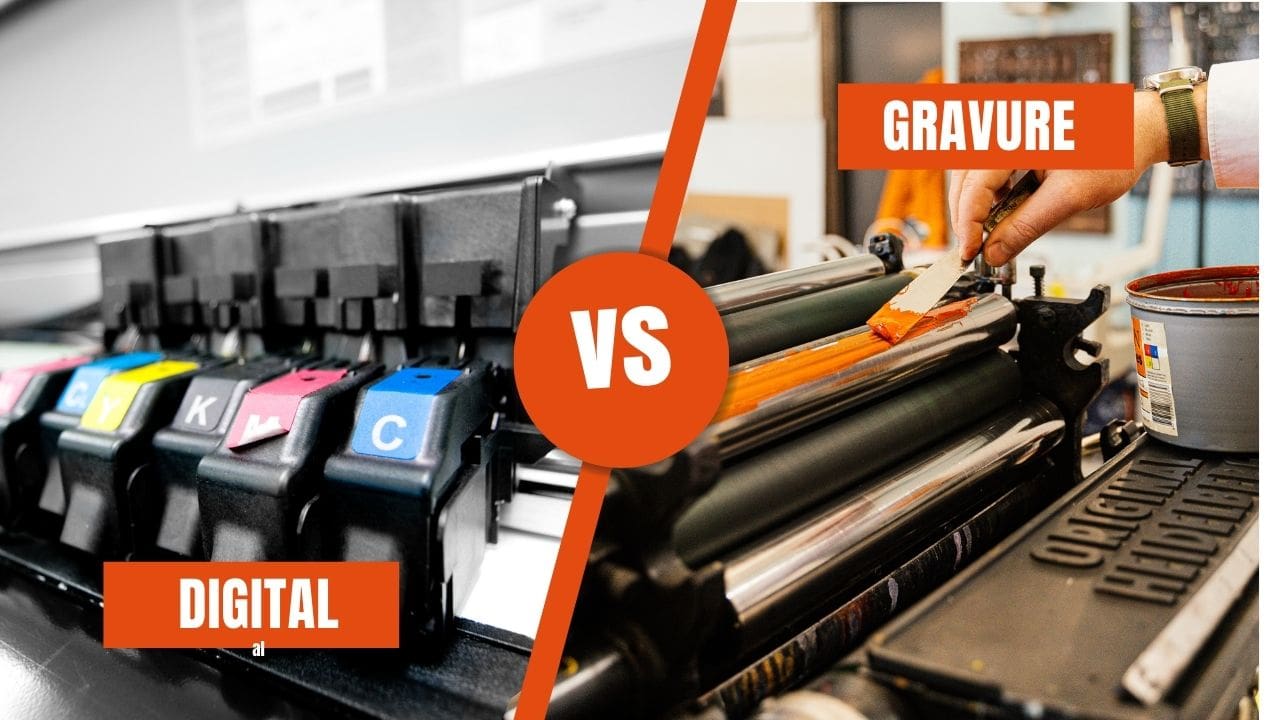
The Strategic Choice: Why Gravure Printing vs Digital Printing Matters
Choosing between gravure and digital printing directly impacts cost, quality, and time-to-market. This decision affects whether your packaging project succeeds commercially.
Gravure excels in high-volume production where cost per unit matters most. Digital printing provides speed and flexibility for rapid market entry.
The wrong choice creates risks: budget overruns on small runs, quality compromises on premium packaging, missed launch windows.
Purpose of the Guide
This guide translates technical differences into business impact. We analyze how each technology affects timelines, budgets, and quality.
Whether launching new products or scaling production, understanding these technologies prevents costly mistakes. We start from your business objective. Your success metrics determine which method delivers optimal outcomes.
Your Cheat Sheet: When to Choose Gravure vs Digital
| Project Requirement | Choose Gravure | Choose Digital |
|---|---|---|
| Run Size | 100,000+ units (e.g., annual snack packaging). | 1-1,000 units (e.g., limited-edition product labels). |
| Design Complexity | Photo-realistic gradients, fine line work (e.g., luxury packaging). | Variable data, personalized text (e.g., direct mail campaigns). |
| Substrate | Flexible films, metal foils, or corrugate (e.g., stand-up pouches). | Paper, coated fabrics, or small rigid substrates (e.g., greeting cards). |
| Color Criticality | Exact Pantone matches for brand logos (e.g., cosmetics packaging). | Non-critical color projects (e.g., internal reports). |
| Turnaround Time | 7-14 days for large runs (planned production). | 1-3 days for urgent jobs (last-minute marketing materials). |
Gravure Printing vs Digital Printing: Understanding the Core Technologies
1. Gravure Printing
Definition: Gravure printing is an intaglio printing process where images are engraved into metal cylinders as recessed cells. Ink fills these cells and transfers to your packaging material.
Core Mechanism: The engraved cylinder floods with ink. A doctor blade scrapes excess ink from the surface. Only ink in recessed cells remains. When your substrate passes between the cylinder and impression roller, pressure transfers ink to create the final image.
Key Components:
- Engraved cylinder: Copper or steel cylinder holding your image as recessed cells
- Doctor blade: Removes unwanted ink from the cylinder surface
- Impression roller: Applies pressure for ink transfer
Business Impact: High setup costs due to cylinder engraving. Once setup completes, extremely fast production and low per-unit costs for large volumes.
For more about gravure printing, click here for ultimate guide for gravure printing.
2. Digital Printing
Definition: Digital printing transfers files directly to substrates without physical plates. Your PDFs or image files print immediately.
Core Mechanism:
- Inkjet systems: Printer nozzles eject precise ink droplets following your digital file pattern
- Toner systems: Laser charges a drum, attracts toner particles, then transfers and fuses them to the substrate using heat and pressure
Key Components:
- Digital printer: Houses the printing mechanism for inkjet or toner systems
- Ink/toner cartridges: Contain coloring materials applied to the substrate
- RIP software: Converts your digital files into printer-readable format
Business Impact: No setup costs or delays. Immediate production start. Higher per-unit costs but ideal for small runs, tight deadlines, and design changes.
For more about digital printing, click here for ultimate guide for digital printing.
Gravure Printing vs Digital Printing: A Direct Process Comparison
| Aspect | 1. Gravure Printing | 2. Digital Printing |
|---|---|---|
| Prepress Setup | Days to weeks. Cylinder engraving required. | Minutes. Upload file only. |
| Ink Application | Engraved cells control ink transfer. | Inkjet droplets or toner particles. |
| Color Management | Precise Pantone matching. | ICC profiles. Limited Pantone accuracy. |
| Substrate Compatibility | Paper, films, foils, fabrics. | Paper, smooth surfaces mainly. |
| Production Speed | Fast after setup. Hundreds meters/minute. | Slower volume. Fast setup advantage. |
Quality and Visual Impact: A Gravure vs Digital Analysis
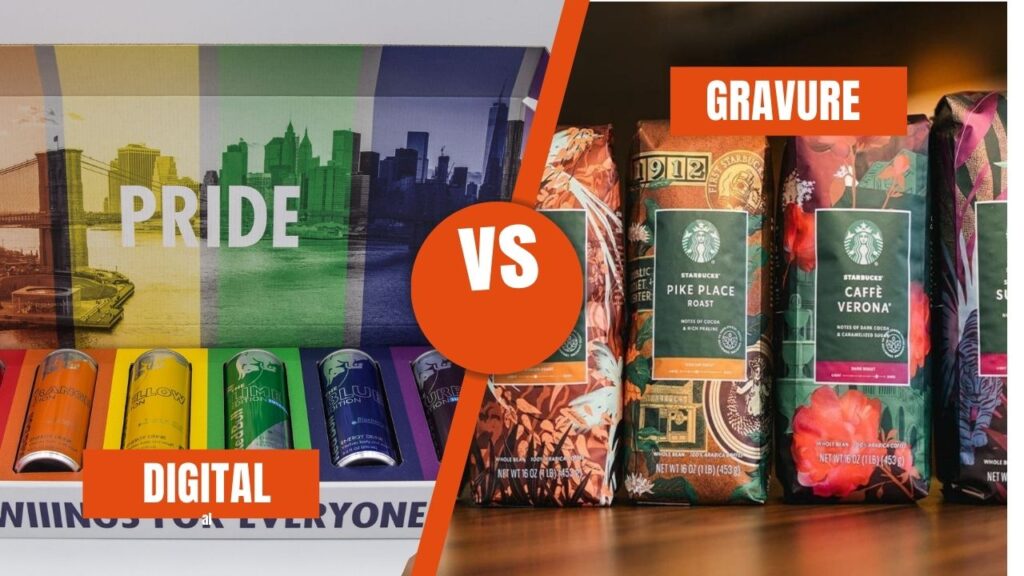
1. Gravure’s Unmatched Detail at Scale
The quality of gravure printing is extremely high. It can produce prints with up to 300 lpi. lpi stands for lines per inch.
This high resolution is excellent for showing fine details. It also creates very smooth color transitions and top-quality images. It can accurately capture tiny parts of a design, making it perfect for luxury packaging or art books.
The secret is the engraved cells on the printing cylinder. These tiny pits allow for very precise control over the ink. This results in sharp and very well-defined prints.
2. Digital’s High-Quality, On-Demand Precision
The quality of digital printing depends on the printer model. Some high-end digital printers can reach resolutions of 1200 dpi or more. dpi means dots per inch.
Digital printing handles detailed designs and text very well. However, in some cases, it can struggle. This is most true with large areas of smooth color, which may not look as perfect as a gravure print.
For very small text or complex lines, digital printing can sometimes show pixelation. This makes the edges look a bit jagged. But, technology is always improving and making these issues smaller.
The Business Impact: Translating Quality into Brand Value
Both methods deliver strong visual results for your brand.
Gravure is for the ultra-high-end, high-volume jobs. Its premium quality justifies the high setup costs when you are printing millions of items.
Digital is now excellent for most professional brand needs. It is also completely risk-free for market testing new products.
The Financial Bottom Line: A Gravure Printing vs Digital Printing Cost Breakdown
Setup Costs: The High Barrier vs. Zero-Risk Entry
1. Gravure Printing
Gravure has very high setup costs. The main reason is making the metal printing cylinder. The process of engraving the cylinder is complex and expensive.
This cost can be from several hundred to several thousand dollars. And for jobs with multiple colors, you need a separate cylinder for each color. This makes the total setup cost even higher.
2. Digital Printing
Digital has very low setup costs. There is no need to make expensive plates or cylinders.
The only real cost is preparing the digital file and setting up the printer. This is fast and cheap. For most small jobs, the setup costs are tiny.
Unit Costs: How Volume Dictates Your Price-Per-Package
1. Gravure Printing
For small print runs, the cost for each package is high. This is because the large setup cost is divided by only a few items.
But as you print more, the unit cost drops a lot. This is called economies of scale. When you print thousands of units, the high setup cost gets spread out, making each item cheaper.
2. Digital Printing
With digital, the cost per unit stays about the same. It doesn’t matter if you print 100 or 1,000 items.
Since there are no big setup costs to spread out, the price per item is stable. This makes digital the cheaper choice for small-to-medium sized runs.
Finding the Crossover Point: Cost-Effectiveness by Volume
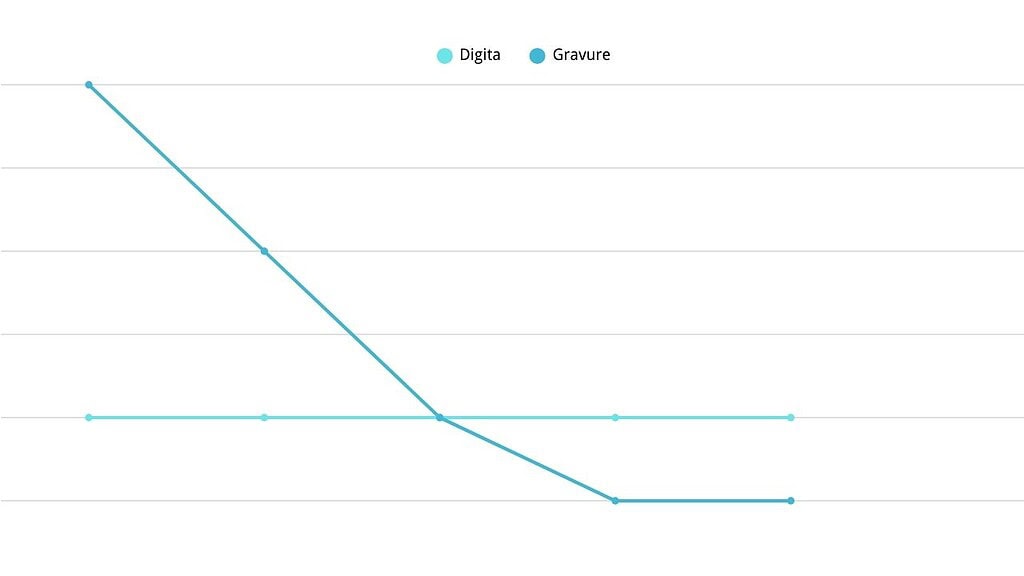
This is the point where one method becomes cheaper than the other. We call it the cost crossover point.
- Small Runs (1 – 1,000 units)
Digital printing is cheaper. The low setup cost makes it the clear winner for small batches. - Medium Runs (1,000 – 5,000 units)
It depends. If your design is complex or changes often, digital is still probably better. If your design is simple, gravure might start to look like a good deal. - Large Runs (5,000+ units)
Gravure printing is cheaper. The high setup cost is now spread over so many items that the unit cost is very low. This is why big brands use it for products on every store shelf.
Our Advice: A Clear Growth Path for Your Brand
We help you go “from 0 to 1, then to 1 million.” We never force you to choose between quality and your budget. Instead, we offer a solution in stages.
- Stage 1: Market Validation (Digital Printing)
Use digital for your first 500 to 1,000 units. This is a zero-risk way to launch fast with a low cost. You can even test a few different designs to see what customers like best. - Stage 2: Growth (Flexo or Offset Printing)
When your orders grow to 20,000+ units a month, digital is no longer the cheapest per item. We will help you switch to flexo (for flexible bags) or offset (for paper boxes). Their setup costs are much lower than gravure. - Stage 3: Market Leadership (Gravure Printing)
When you are making 500,000+ units in a single run, it’s time for gravure. The setup cost is now amortized, or spread across a huge volume. This drives your cost per package to the lowest possible level.
Gravure Printing vs Digital Printing: Flexibility and Customization
Printing Unique Information on Each Package
1. Gravure Printing
This is very hard to do with gravure. The design is physically engraved onto a metal cylinder. If you want to change anything, like adding a person’s name or a unique code, you need a whole new cylinder. This is slow and very expensive.
2. Digital Printing
Digital is perfect for this. The process is called Variable Data Printing (VDP). Because the design is just a file, you can easily tell the printer to change information for every single package. Adding different names, addresses, or contest codes costs nothing extra.
Substrate Versatility: Matching the Material to the Method
1. Gravure Printing
Gravure can print on a lot of different materials, which are called substrates. This includes paper, plastic films (like for chip bags), and even thin metal foils. However, the surface of the material has to be just right to make sure the ink transfers correctly.
2. Digital Printing
Digital also works well with many materials, especially paper. Some digital printers can also print on coated fabrics or hard surfaces. But, it can have problems with materials that are not absorbent (non-porous) or have a very rough texture. The ink might not stick as well.
Design Iterations: The Cost and Speed of Change
1. Gravure Printing
It is costly and slow to change a design with gravure. Any small tweak requires a brand new cylinder to be engraved. This can take days and add thousands to your cost. This makes it a bad choice if you think you might want to update your design later.
2. Digital Printing
It is easy and cheap to change a design with digital. You just edit the computer file. This costs nothing and can be done in minutes. This allows you to test different versions and make adjustments easily. It’s perfect for projects where the design might evolve.
Our Advice: A Path Built for Growth and Safety
Our main goal is to give you a risk-free, scalable path. It is a mistake for a new brand to jump straight to gravure printing.
We always start you with digital. This lets you launch fast and change your design easily. As your business grows, we move you to flexo or offset printing. Only when you reach true mass production do we recommend gravure.
You never have to choose between two extremes. We show you the safe, profitable middle ground that exists between them.
Gravure vs Digital Printing: Industry Applications and Use Cases
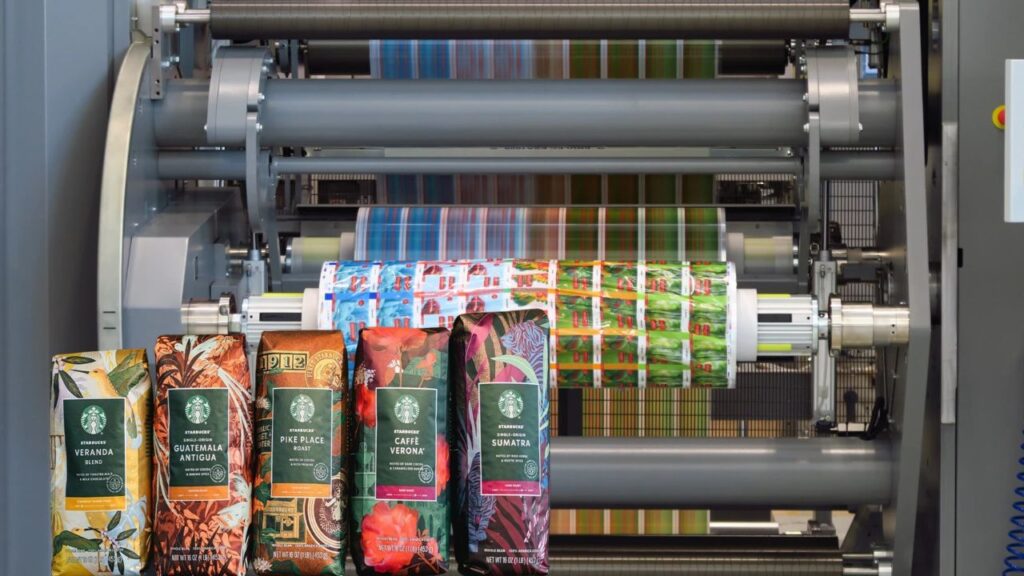
Gravure Printing Applications
1. High-Volume Packaging
Gravure printing is a leader in the packaging industry. It is mainly used for very large production runs.
Think of items you see in every supermarket. This includes flexible packaging like snack bags, coffee pouches, and candy wrappers. The print quality is excellent, colors are bright, and it works perfectly on these flexible materials.
It is also used for rigid packaging. This includes things like metal beverage cans or printed plastic containers. The print from gravure is very durable. It can also produce sharp, high-resolution graphics that make products look premium on the shelf.
Digital Printing Applications
1. Prototypes and Market Samples
Digital printing is ideal for creating test versions of your packaging. You can produce a small number of high-quality samples. These are perfect for sales meetings or consumer testing. You can get feedback before committing to a large, expensive print run.
2. E-commerce and Customization
Digital plays a huge role in e-commerce. It is perfect for on-demand printing. This means you can print custom-designed shipping boxes or packaging for subscription services as you need them. It allows for personalization, which makes the customer’s experience feel special.
3. Short-Run and Promotional Packaging
Digital is the best choice for short production runs. This is useful for seasonal products, like a special holiday-themed package. It’s also great for launching a new product in a specific region. The low setup cost makes printing small batches affordable.
The Future of Print: Gravure and Digital Innovations
Both gravure and digital printing are constantly getting better. New technologies are making them faster, more capable, and more sustainable.
Advances in Gravure Printing
- Digital Engraving: Instead of older, slower methods, cylinders are now engraved with high-precision lasers. This makes the setup process 30% to 50% faster.
- Extended Color Gamut (ECG): Gravure can now use a standardized set of inks (often 7 colors) to match the vibrant colors produced by digital printers. This ensures your brand colors look consistent across all your packaging, no matter how it’s printed.
- UV-Curable Inks: New eco-friendly inks are becoming more common. They are cured instantly by UV light, which reduces harmful emissions (VOCs) compared to traditional inks, while still being very durable.
Advances in Digital Printing
- High-Resolution Inkjet: The latest digital printers can produce an incredible range of colors and capture extremely fine details, closing the quality gap with gravure.
- Nanoink Technology: These special inks contain tiny nanoparticles. This allows for smoother color gradients and sharper text, especially on non-absorbent materials like plastics and foils.
- AI-Driven Color Correction: Smart software now automatically adjusts colors during printing. It compensates for slight differences in materials, ensuring the final print looks exactly as intended.
Hybrid Solutions: The Best of Both Worlds
Sometimes, the best solution is to combine technologies.
A common hybrid approach is Gravure + Digital Overprint. Here’s how it works:
- The main, static parts of your design (like your logo and background colors) are printed with gravure. This is very cost-effective for large volumes.
- Then, on the same production line, a digital printing head adds the variable information. This could be unique QR codes, contest numbers, or different languages for different regions.
This method gives you the low unit cost of gravure and the customization flexibility of digital.
Gravure vs Digital Printing: An Environmental Impact Comparison
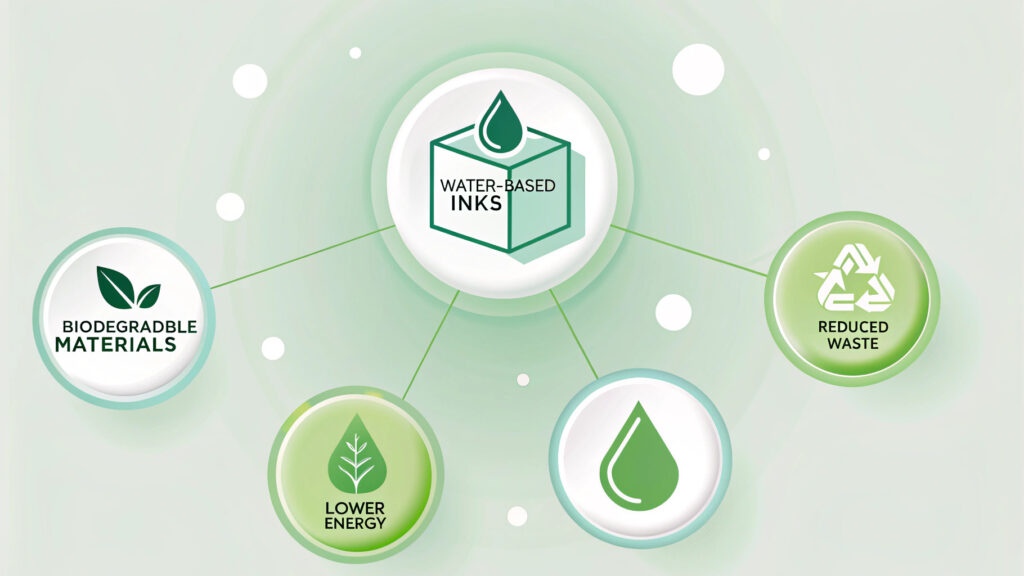
For modern brands, sustainability isn’t just a buzzword; it’s a core part of building customer trust. The printing choices you make have a direct impact on your environmental footprint, and we help you make responsible decisions at every stage of your growth.
Gravure Printing
Gravure printing has traditionally faced environmental challenges, but new options are making it a greener choice for mass production.
- Ink Choices: Historically, this method used solvent-based inks, which release Volatile Organic Compounds (VOCs) into the air. However, this is no longer the only option. You can now specify the use of water-based inks, a much more eco-friendly alternative that dramatically reduces emissions.
- Waste and Energy: The process inherently creates waste from used metal cylinders and consumes significant energy due to the large presses and ink-drying systems required. Partnering with facilities that have robust recycling programs and energy-efficient operations is key.
Digital Printing
For new and growing brands, digital printing is often the most sustainable starting point.
- Greener Inks: Many digital printers use water-based inks or biodegradable toners by default, minimizing environmental impact from the very first print run.
- Minimal Waste: Because there are no plates or cylinders, waste is drastically reduced. Furthermore, many ink and toner cartridges can be returned to the manufacturer for recycling, closing the loop.
- Lower Energy Use: The technology is simply more energy-efficient, especially for the small-to-medium runs that are perfect for market launches and product testing.
Conclusion
In short, gravure printing offers unmatched quality for massive production runs, while digital printing provides the agility needed for customization and smaller batches. The most effective strategy often combines both, using gravure for foundational designs and digital for personalized details.
Ready to build the right printing strategy for your brand?
Contact us for a consultation. We’ll help you map out a cost-effective, scalable plan that grows with your business and ensures you are always using the most powerful technology for your specific needs.
 English
  العربية
  Deutsch (Sie)
  Español
  Français
  日本語
日本語  한국어
한국어  Italiano